

Welcome to the Macoun Field Club!
The Macoun Club was established in May 1948 as a joint venture of the National Museum of Canada (Museum of Nature) and the Ottawa Field Naturalists’ Club; since 2010 it has continued under the sole sponsorship of the OFNC. This group is for children and teenagers aged 8 to 18. Activities normally take place on Saturdays during the school year.
Families can enquire about the Macoun Club at any time. Either phone Rob Lee at (613) 623-8123 (note that “Macoun” rhymes with “crown,” not “croon” — it is named for a famous Canadian botanist of the late 1800s), or e-mail him at Macoun[at] ofnc.ca. The Macoun Club is sponsored and supported by the Ottawa Field Naturalists’ Club (OFNC); there are no fees.
Autumn 2026 schedule
Indoor meetings will alternate with field trips on Saturdays. Sometimes we hold two age-defined meetings in a morning, but usually a single, 2-hour meeting, from 10 a.m until noon. At the Fletcher Wildlife Garden, there is parking nearby, but not at the building. See just below for more information on location and parking there. (Some meetings are held at the St Laurent Academy.)
Field trips will take place on the alternate Saturdays, typically from 10 a.m. until 3 p.m., all ages together. Details of exact times and locations are revealed only to families that either contact Rob on the Thursday or Friday before the trip, or register online once their child is registered as a member.
Schedule of events
Nov. 21: Field trip
Nov. 28: Indoor meeting: Introduction to Birding and Bird Counts, with Deborah Doherty
Dec. 5: Field trip
Dec. 12: Indoor meeting
For further information, contact Rob for details (and to register for trips). You can reach him at 623-8123 or e-mail him at macoun[at] ofnc.ca. Exact hours and locations of field trips are provided only when registering for them.
LOCATION, AND PARKING FOR MEETINGS: Except for special occasions, we meet in Building 138, the “OFNC – Interpretive Centre,” as it appears at a Google Maps pin, the building at the very end of the lane running east to the Fletcher Wildlife Garden from Prince of Wales Drive, the lane across the road from a big parking lot for the Agricultural Museum. There is no parking for parents at Building 138, or under the trees along the lane; if you want to stay while your child is in the meeting, park in the areas designated between the baseball diamond and the first building you come to, no. 136.
For families that remember how it was before, this year Agriculture Canada will ticket cars parked under the trees along the lane to Building 138, as it is considered an emergency-access route.
See what we did last year
Here’s what we’ve done this year:
November 14, 2026: From the field to the microscope
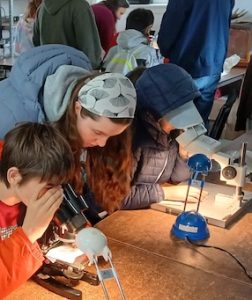
We had samples from our own Study Trees to examine
For weeks we’ve been gathering specimens to examine under magnification — vials of pond-water and envelopes with tree-bark samples — and today set up microscopes around the room. Then waited patiently through Hugo’s observations of migrating waterfowl and Rob’s of a Painted Turtle “basking” in the rain.
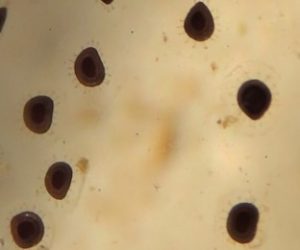
We had collected the overwintering cysts of bryozoans weeks ago
Finally there was a mad rush to any available spot. Most stations were set up with “dissecting” microscopes, magnifying about 15x; there was one compound microscope, at about 50x.
We got to see the overwintering cysts (statoblasts) of the bryozoan colonies seen on October 24th. And mInute living things were moving about in the water, notably a single-eyed crustacean, a Cyclops that a child could just see moving in tiny jerks. The bark specimens mostly held mosses and liverworts, and some lichens. Rob had identified some of the lichens: the Trumpet Lichen, Cladonia fimbriata, from Max’s White Birch; a Gray-rimmed Firedot lichen, Caloplaca cerina, from the trunk of Elizabeth’s Rock Elm, and a Candle Lichen, Candelariella concolor, from Alma’s Sugar Maple. The mosses will have await another day.
November 7, 2026: Visit to the Study Tree Woods
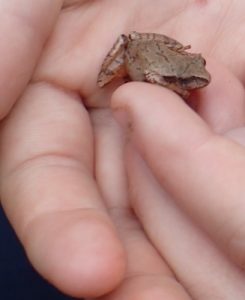
Spring Peepers were active enough to leap out of our hands
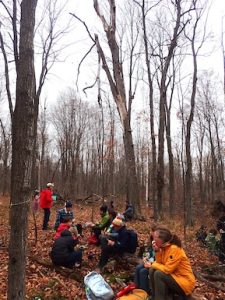
With so many logs now lying in the forest, lunch happens wherever we happen to be
It was a gentle day for November: overcast, with a high of 10ºC. Although Rob had seen a Painted Turtle out on a water log on his drive in, it was not warm enough to entice any snakes out. Hoever, we repeatedly found Spring Peepers active in the leaf litter. Yet the season was far enough advanced for an American Toad to have already gone into winter quarters; we found one tucked into a tight little cavity in the ground directly under a log, with only its nose showing.
We visited our Study Trees and looked at them with a special interest in the other life forms growing on them — most had mosses, liverworts, and lichens growing on the bark. When lunchtime came, we sat around on logs close to, but not under, a Study Tree with a big, hanging limb high above. That tree has masses of big, flat bracket fungi that have sprouted out of the upper trunk.
To wind things up, Rob led the group into the adjacent forested floodplain, skirting the wet sedge meadow that occupies Pond IX when the spring floods drain away.
Oct. 31, 2026: Susan’s Top Ten Spooky Things in Nature
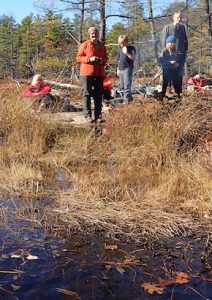
Photo of Macoun Club speaker Susan Lehmann in Halloween colours on the previous week’s field trip
In honour of the last day of October, Macoun Club leader Susan began with an orange-and-black dragonfly, the Halloween Pennant. Spooky? Only if you’re a mosquito larva.
Some of her choices were influenced by their lifestyles, such as the Zombie Worms that are able to dissolve the bones in decomposing whale carcasses that have sunk to the bottom of the sea. Another was the Shaggy Mane mushroom, also known as an Inky Cap for the way it turns to blackish goo after passing through its edible stage. The product of its deliquescence is a genuine ink, used by some artists. She showed us drawing that had been produced with natural, untreated mushroom ink
She finished with a bird with a bizarre colonial habit that would kill most birds. Before we thought too hard about it, she revealed that it had come to her in a dream.
Oct. 24, 2026: Rare bryozoans in a special pond
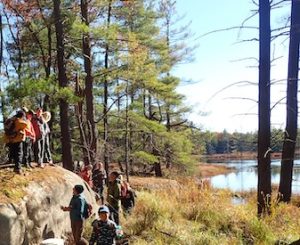
No roads, not even ATV trails, approach this remote place
Way at the back of Gerry Lee’s land in the Pakenham Hills lies a lovely, lake-like body of water, ringed with stands of White Pines and bound by granite shores. It’s a long walk to get there, over an unmarked and now nearly forgotten trail, followed by a careful traverse of a long, muddy beaver dam, and then yet another obscure footpath.
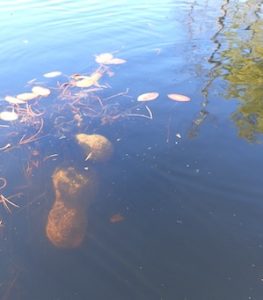
There were dozens of these basketball- sized globes of jelly in the pond
We gathered firewood for our lunch fires, right by the water. At one of them, children and adults alike were both appalled and entranced by the life-and-death struggles of a Mink Frog that had been seized by a Giant Water Bug.
Some of us had time to explore this pond — its islands and bays — by canoe. Almost the first thing we found out there were ball-sized blobs of soft-yet-firm jelly loosely moored to the stems of Watershield plants. Mike and Rob recognized these immediately as fresh-water Bryozoans — colonial, filter-feeding animals — in the last stages of their annual life cycles. The balls of jelly (soft-ball size to volleyball size) had produced thousands of brown cysts ready for release as winter comes on.
Oct. 17, 2026: Oaks, acorns, birds and weevils — and us
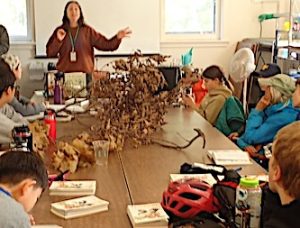
With a fallen oak branch, laden with acorns, on the table, Sarah explained the importance of oaks to squirrels, blue jays, acorn weevils, and people
Like maples, oaks are among the several dominant types of trees in the Ottawa area. We may be aware that squirrels work hard gathering the acorns as winter approaches, and even know that acorns can also be processed into food for foraging humans. But Macoun Club leader Sarah Walker led us to see so much more about these important trees.
Drawing on recent research, as well as her own longstanding interest in wild foods, Sarah broadened the range of wildlife that are tied to oaks to include acorn weevils and Blue Jays. Jays have an adaptation for gathering acorns — a “gular pouch” that lets them pack in six or seven acorns and carry them to places where they can be stored. Yet, she said, Jays cannot digest the acorns because of their toxicity. They get their food from the beetle larvae (weevils) that attack so many acorns from within. (Rob spoke up to say he has eaten such weevilled acorns, and assured us that they taste like nuts, instead of being bitter.)
To remove the bitterness, Sarah said, you either have to choose an oak species with sweeter acorns, or grind up the acorn kernals and soak or boil the resulting flour. Archaeologists have found evidence to show that humans have been doing this for at least 10,000 years, especially in Europe, and there are indications that ancestral humans were foraging for acorns hundreds of thousands of years ago. It may be, she said, that the modern global distribution of oaks after the Ice Age was determined by the movements of early peoples, taking the seeds of the oaks with them to new places.
She finished with samples of chocolate chip cookies made with her own acorn flour.
October 3, 2026: A different part of Stony Swamp
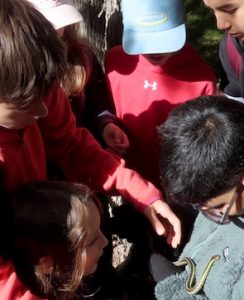
It’s a relaxed snake that reclines on your chest
We visited a different part of Stony Swamp today, about a mile southwest of our familiar Study Area. While we still milled about in Greenbelt parking lot P10, flocks of Canada Geese came overhead. Someone called out, “There are Snow Geese with them!” and indeed a trio of smaller, white geese were moving between one flock of Canadas and another. At our feet, invited leader Nathan Stevens-Cocco spotted a Water Snake basking beside the water-filled ditch there and picked it up. After that we found other snakes — Garter and Red-bellied — in various habitats.
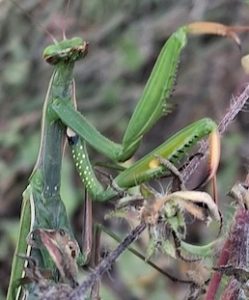
The Praying Mantis can turn its head to look at you!
We divided into three groups, one forging ahead, the others paying closer attention to hollow Horsetails, fluffy Clematis seeds, and the creatures under logs, such as Blue-spotted Salamanders. We all met up again for lunch around the ruins of the 19th-century lime kiln that gives this trail its name. There we had Chickadees coming to hand in hopes of finding handouts.
From there, we all pushed west through a region that had burned in a forest fire (in 2012) and the adjacent open expanse of grass and bare rock — a genuine calcareous alvar. There we found fuzzy Salt-Marsh-Moth caterpillars, a Two-striped Grasshopper, and lots of European Praying Mantises. We noticed black-and-white spots in the mantis “armpits” and Nathan explained that these may serve to startle potential predators, the way false eyespots do.
Sept. 26, 2026: Outdoor art workshop
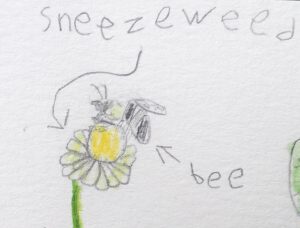
Drawing from life: a bumblebee visiting a flower
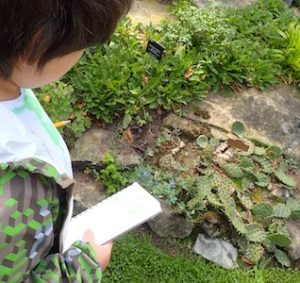
Contemplating drawing a cactus
Since we’re meeting right in the Fletcher Wildlife Garden, it was so easy to take our art workshop outside on a sunny autumn day. The grounds were full of native wildflowers in bloom, with bumblebees and other pollinators busy in the flowers. The bees and other arthropods — spiders, centipedes — were our member’s favourite subjects. But a Grey Squirrel with a red tail drew one artist’s attention, and a Chickadee another’s. The drawings will be featured in our Club’s in-house magazine next spring.
Sept. 19, 2026: Salamanders galore!
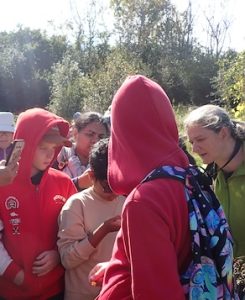
Snake! Salamander? Praying Mantis! Everyone wants to see!
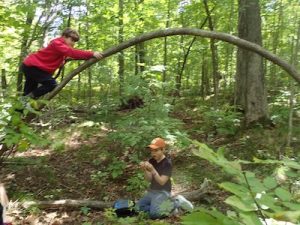
Some go high, some low
We made a return to our Nature Study Area in the western Greenbelt, and in the forest began finding salamanders under logs right away. Blue-spotted, and Eastern Newt/Red Efts. But there were few slugs or ants. In an open place with bare rock showing, we found several Garter Snakes.
In that small part of our Study Area that is devoted to Study Trees, we checked on those chosen in past years, and some new members chose their trees. One parent had been a Macoun Club member herself, and when she revisited her Ironwood that was waist-high in 1991, she found it 6 metres tall now!
We finished up by checking on the long-abandoned homestead orchard near the Trans-Canada Trail. Two trees were bearing fruit, but it tasted very sour. Macouners who remember this place looked in the long grass for European Praying Mantises, and found them. And we parted the bushes to see a memorial placed in ruins of the old ice-house (just a jumble of rocks now) by the family of people who grew up there in the 1930s.
Sept. 12, 2026: First meeting of the year
We shared a summer’s worth of observations, then went outside to explore the Wildlife Gardens. There were Green Frogs and tadpoles in the little pool, and wildflowers in full bloom.
Here’s what we did last year:
June 13, 2026: End-of-Year party
The group assembled to review the year, present awards for strong participation, and watch the Bill Mason film, “Rise and Fall of the Great Lakes.” Issue No. 78 of The Little Bear was eagerly examined by everyone. We were joined by a small reddish-brown weasel that ran around the room while everyone tried to get a look at it.
June 6, 2026 – Fish Survey and Identification

We waded right into the pond to sample the fish population
Having honed our fish identification skills last month, we headed back to the Museum of Nature Collection and Research facility in Gatineau to put these skills to the test. Some of the Macouners got their fit wet quite literally as they waded into the pond to check minnow traps, use nets to sweep for samples, and hauled in the seine net to examine their catch.

One by one, we identified the fish
Then the minnows were brought to tanks at the fish ID station and one by one they were put in the fish photo tank to examine, identify and take pictures of. When put to the test Darwin managed to list all five species identified during his time at the fish ID station.
Besides the fish, we also got a chance to see some Painted Turtle eggs, have a close encounter with a browsing deer and catch a glimpse of the Green Herons nesting nearby. Bycatch from the fish collection also turned up some macro-invertebrates including dragonfly nymphs and a Water Scorpion.
While the rain held out until after the event was over, somehow Owen and Mihir still managed to get soaked up to their necks, but like the fish, they didn’t seem to mind at all!
May 30, 2026: Seeing our Study Trees from space

Robin chose this tree in January; in June we realized that its scraggly branches can be seen from space
It’s only a 10-minute walk, but there was so much to see along the way — Wild Strawberry in flower, tiny blue butterflies, a Grey Squirrel family chasing around in the treetops — that we were slow in getting to our Study Trees. But when we got around to visiting them, we discovered a view of them that no Macoun member has ever had before.

Three “Study Trees” can be distinguished in this Google Maps image, Robin’s at top-left
Prompted by one of the leaders, Robin checked out Google Maps on his cell phone and found that on an image obtained by a satellite in space, he could distinguish his big Sugar Maple tree from all the others — because its branches are scraggly and dead, while all those around it have leafy, green crowns.
Robin’s tree is dead and rotting, and insect larvae are burrowing inside the wood. The trunk was swarming with Ichneumon Wasps, which lay their eggs in such larvae.
Robin’s tree is over at the left in this image, near the reddish spot. Sixty metres to the east is another dead tree, this one lying flat, having fallen last year. Owen chose it (a White Birch) last September 13th.
In between the two is a black hole in the forest canopy. This is where Mozz’s tree got blown half-over in 2023. It still lives, but it’s leafy top is displaced to the right of the space it used to occupy.
While we were in the forest, we heard all the woodland birds singing and calling: Black-throated Green Warbler and Redstart, Ovenbird, Red-eyed Vireo, Eastern Wood Pewee. One boy spotted a Spring Peeper hardly bigger than a thumbnail, but it is so late in the season that all the amphibians have fallen silent.
May 23, 2026: A history of evolutionary weirdos
 Robbie Stewart set out to shift our thinking about the process of evolution, our ideas having been built around concepts implicit in English language and culture. By way of example, he pointed out that we think of ourselves at being at the apex of a pyramid of animal life — a structure we refer to as a “Kingdom.”
Most of English history is described as a chain of cause-and-effect based around humans acting with intent. By extension, we imagine evolutionary processes as leading step by step to ourselves, from fish through amphibians and reptiles to mammals. But adaptations aren’t new technologies that different animal groups are rolling out — they are alterations that, by chance, turn out to be useful in the environmental circumstances organisms find themselves in.
Robbie outlined three different kinds of evolutionary paths: directional selection (repeated selection of one extreme of a trait), stabilizing selection (preserving the average traits in a population), and disruptive selection (when both extremes in a population have an advantage over the average).
Disruptive selection produces all the “weirdos” that are so much fun to look at, and his presentation was full of pictures of them. These weirdos became experts in certain niches where there wass less competition. Robbie closed his talk with the one trend that is consistent over time – the apex predator is always the first to go in a mass extinction event.
May 9, 2026: Museum collections and fish-identification workshop

Mattia and Robin with a pickled sturgeon
Katriina Ilves, an ichthyologist at the Museum of Nature, organized and hosted a special fish ID workshop and tour of the Collections facility in Gatineau for us.
In the workshop Macouners got a primer on the main features to look for in fish identification, and could then move through a series of work stations to practice their skills. One station focused on how several species-at-risk look remarkably similar to other, very common fish; sometimes it’s something as small as a dark spot by the caudal fin that differentiates them. Another station let us use magnification to count the scales along the lateral line. At a third station Macouners were given photos of various fish to match to the jars of specimens on the lab bench, and offered a guide book to try and identify them. But of course the coolest part was just seeing all the specimens which the museum staff were happy to take out of the jars for us to examine, including a sturgeon and lampreys. There were also two specimens too big to fit in jars – a Coelacanth and a freshwater Drum. Coelacanths were considered extinct until rediscovered in 1938.
On the collections tour we got to see just a small sample of the vast collections that the Museum has. In the herbarium we learned that John Macoun’s 1879 sample of “Macoun’s Shiny Moss” is the only sample to have ever been collected. In the fish-and-amphibian collection we saw rows and rows of shelves lined with jars of samples, while in the mammals section we saw taxidermy specimens, a wall of antlers, whale jaw bones longer than a canoe, and more! It was like Christmas where it seemed anything the kids could think of, the museum staff could find it and show it to them!
May 2, 2026: Drawn to water like moths to a light

Even a floating sedge mat has a moat!

Tending the campfire
We returned to one of our favourite places, “Pakenham,” “Gerry Lee’s,” and, for our lunch fires, Rock Wall Pond.” Along the way we found Hepatica coming into bloom, some blossoms white and some mauve. (We also found a Coltsfoot flower, but that’s a sore point, because this plant is invading along the roadside.)
Passing by some very good lunch places, we made for “Rock-Wall Pond” where we have a safe place for making campfires — bare rock beside a water source. Some were keen on getting out on the floating bog, forgetting that it’s still icy cold out there. Nolan settled for a floating sedge mat, and very nearly settled into it — he couldn’t get back to shore without help.
We visited Gerry Lee’s cabin, and not finding him home, searched for prizes in his bone pile.
No salamanders came to light until the very end, as we walked out.
April 18, 2026: Something for everyone!

We netted some really interesting creatures
Mike Leveille had organized a biosurvey of the Macoun Marsh, in Beechwood Cemetery, intending that the Macoun Club would hunt around and compile an impressive list of the living things in that remnant of a once-great wetland. Our members were divided into small groups that found sampling stations around the open water. Right in front of the observation building, kids were splashing around and netting such things as mosquito wrigglers and Backswimmers. One boy’s prize find was the larva of a Phantom Crane Fly. Mike’s was a Water Bear, or tardigrade. It could be appreciated only under a microscope.
Red-winged Blackbirds and Cardinals called. Out on the water a gorgeous pair of Hooded Mergansers moved about nervously, and two Canada Geese contended over the right to breed there, one noisily chasing the other from place to place, so that it had no peace.
And though the event was conceived of as a survey of living things, a part of our group was diverted by a nearby heap of black shale and sought out the long-dead creatures of the Ordovician — trilobites and nautiloids.
April 11, 2026: Musk Turtles
 Dave Seburn (aka “The Turtle Guy) from the Canadian Wildlife Federation talked to Macoun Club today about the Musk Turtle (Sternotherus odoratus). The Musk Turtle is also known as the Stinkpot because when it’s disturbed it can produce a musky, skunk-like scent.
Dave compared the Musk Turtle to several species that Macouners are more familiar with, such as Painted and Snapping Turtles. Musk Turtles are much more elusive than them, and little is known about their general habits. It has always been thought that Musk Turtles do not venture very far from their regular body of water but Dave recounted a story of how his team found one that had died much farther away from water than anyone would expect. This prompted them to look at all the observations of Musk Turtles posted on iNaturalist and found that indeed they may on occasion travel further than previously thought. What prompts them to go on such adventures (rain? looking for new bodies of water? bored?) is still a mystery.
The Macoun Club was very engaged in the presentation and talk turned to all sorts of topics, so that Dave had to make a rule that any further comments be restricted to the topic of turtles. Which is how we learned that ostriches (brought up by Zak), are NOT turtles (or so Hugo claims, though the rest of the Macouners did seem to agree with him).
To read more about the travelling Musk Turtle discovery: https://blog.cwf-fcf.org/index.php/en/swimming-in-musky-waters/
March 28, 2026: Fifty years of birdlife change in Ottawa

Roy John related changes in bird populations to changing habitats
Roy John has been watching birds all over the world, but given free choice he elected to talk to us about the birds around our homes, in Ottawa, and the changes he has witnessed over the past 50 years. Given the state of the world, one would expect him to reel off a litany of declines left and right. But in Roy’s overview, losses have been few.
One of the biggest changes, he said, has the development of a local population of Canada Geese. Prior to 1970, there was none. Arctic-bound geese would pass high overhead at the beginning of May, and after a summer’s absence, pass over going south in early October. Now there are many tens of thousands of Canada Geese that stay most of the year and nest locally. You can see them crossing city streets. Why?
It was someone’s choice, an idea put into effect. In 1970 local enthusiasts obtained 70 goose eggs, hatched them, and released the birds when they could look after themselves. They have multiplied enormously.
Roy talked about other species — House Finches, Turkey Vultures, Common Gallinules, Killdeers, Savanna Sparrow, Barred and Great Horned Owls — an in each case related the story behind their changing status as he understood them.
March 7, 2026 – Nature Art Workshop

Pencil sketch of Ring-billed Gull
Macouners regularly use their Peterson Field Guide to Birds to look up or identify various birds that are mentioned during observations. These books are also great models for our art work. But what did the original bird guide illustrators use as models? How did John James Audubon create his iconic Birds of America illustrations? How was he able to make such detailed and accurate drawings if there were no photographs, when many of these elusive birds were hard to spot, far off in the distance, or constantly moving? The grim answer is that he shot birds and wired them into lifelike poses so that he could then paint them in watercolours using a grid system to create accurate, life-sized, and detailed illustrations.
As we all imagined the smell if we had to paint dead specimens, we all gratefully returned to our books to draw and paint our favourite birds. For those who wanted to use 3-D models, the Macoun skull collection provided inspiration without any worries of rotting flesh.
Feb 28, 2026 – Mudpuppy Night in Oxford Mills

Mudpuppies were netted in the creek and brought to shore for viewing
This evening we had a special “Mudpuppy Night” field trip. Mudpuppies (Necturus maculosus) are large, permanently aquatic salamanders. They go undetected in many water-bodies because of their secretive habits. Mudpuppies are most active at night and in winter. One of the best places to see them is in Oxford Mills where Fred Schueler and Aleta Karstad have been studying the mudpuppies since 1998, and in 2005 were awarded with the CARCNET Silver Salamander Award for local herpetological conservation and education.

Mudpuppies in the tub
We gathered in the parking lot between the bridge and the dam on Kemptville Creek (a tributary of the Rideau River) around 8 pm, and headed down to the water’s edge where Fred’s volunteer helpers had already caught several mudpuppies for us to examine in a tub. Alma quickly identified distinguishing features regarding their size and the distribution of spots on their bodies to tell individuals apart. Everyone found it astonishing that these salamanders could be active in such cold water, a fact that was driven home to the kids who submerged their bare hands in order to experience first hand what a mudpuppy feels like – slimy! Occasionally the volunteers had to change the water in the bin as ice would start to form on top.
Feb. 21, 2026: What is your favourite insect?

Rory showing off his select collection
Not everyone has one. One girl said she doesn’t even like insects.
But Rory Hogan has 10 favourites, and he brought them in, as pinned, labelled specimens in an open-topped display box. One by one he went through the list, explaining with projected images why each, in his opinion, is the coolest. He had pinned a Robber Fly, a dragonfly, a Wood Roach, a Bee Fly, and a Water Strider. (Did you know that there are marine versions of this insect? We see them on any woodland pool, pond, or lake. Yet there are hardly any insects in the marine world.) He worked up to his coolest insect of all, the Big-headed Fly. For no reason other than its huge head.
When Rory’s box of pinned specimens came around the table, it was the little girl who had said she didn’t like insects who spent the longest time, by far, peering in.
Maybe Rory’s made a convert.
Feb. 7, 2026: Canada’s national plant collection

Nathan subsequently took us into the herbarium and showed us historical plant specimens
The scientific basis for all knowledge of the natural world is a reliable collection of documented specimens. Nathan Stevens-Cocco, a collections technician with the Museum of Nature, talked to us about the museum’s plant collection — a herbarium.
What, exactly, can go into a herbarium? Plants, of course, but what counts as a plant? Flowers and trees, obviously, but what about kelp? Or pond scum (both are algae)? How about mushrooms? The herbarium draws the line at mushrooms, but does encompass lichens, which are composites of fungi and algae.
A national collection should represent the territory of Canada, and even after 150 years (since the time of John Macoun) there are gaps. Botanists are sent out from the Museum every year to sample the plants in remote parts of the country, and as Nathan showed pictures of these expeditions, Rob began recognizing a series of Macoun-Club-connected people.
There was Ernie Brodo, leader of the Macoun Club between 5o and 60 years ago, and Paul Hamilton, one of the members in those days, who came back as a leader from 1986 to 1988. Laurie Consaul, a leader around 1990, and Jennifer Doubt, who one day around 2004 came out and identified the mosses growing on Macoun members’ Study Trees.
We made plans to visit Nathan at his place of work.
January 31, 2026: The lunch fire was our focus

Which are better, traditional or “high-tech” snowshoes?
On a chill, grey day at the coldest time of year, we all wanted a good, hot lunch fire — and we made it in Rob’s forest near White Lake, in Lanark County. Once everyone had been fitted out with snowshoes, we trailed back into the woods, looking all around for an adequate supply of firewood. We found such a place, with dead conifer branches on both standing and fallen trees.

As soon as we had heat, the boots came off
Once we had a good blaze roaring, boots came off and cold feet were extended toward the fire, competing with hands holding roasting sticks. Some cooked sausages, others heated sandwiches, or made hot chocolate by melting snow in a pot. And fresh fuel had to be brought in at the right times (which is just before the flames would begin to die down).
Twice, small groups made short forays into the surrounding woods. On a small rise of ground with a view, Rob’s group found a cluster of five “deer beds,” half-moon shaped hollows sunk into the snow where deer had settled down and curled up. From such a place, the deer can keep watch for coyotes.
Back in Rob’s basement, we warmed up before the blaze in his wood stove, and looked through the books in the Macoun Club library, which is housed there.
January 24, 2026: “Do you understand me?
Do the animals in our lives — pets, for the most part — understand anything of what we say to them? By way of introducing the topic, Rob recounted several anecdotes:
A small boy running across a lawn stops and calls out to a bird he had scared up, “Excuse me Mister, you dropped your worm!”
A man (heard on the radio) engages in an involved conversation with one of his cats by means of a button-pad on the floor. He responds by taking the other cat to the vet to have a reported ailment checked out, and the diagnosis verifies what the first cat told him.
Our friend, Gerry, at Pakenham, demonstrates how his Irish Setter can fetch named objects: “Fetch the gloves!” (the dog ran off and brought back one glove). “Fetch the other one!” (the dog looked about in confusion, despite being urged repeatedly).
These stories demonstrate, at the very least, that people believe that the animals understand. Gerry’s dog evidently understood part of what was said to it; he thought it understood more. Proving that they really do scientifically is challenging.
Chimpanzees and Gorillas in captivity have been taught sign language, and Rob found what they sign to be recognizable and make sense when he saw it on TV. Specially trained Parrots, most famously the African Gray named “Alex,” can take part in repetitive question-and-answer exercises, getting a statistically valid proportion of the answers right over a period of many years.
With Alex, careful questioning explored the bird’s ability to distinguish materials, numbers, and colours. With our own pets, or wild animals we come to know individually, we have a chance to get a glimpse into other minds if we are both receptive and critical in our thinking.
January 17, 2026: Snowshoeing in the Study Area
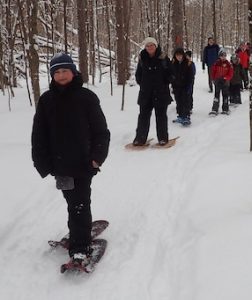
Macouners on snowshoes
The fresh snow, 20 cm deep, was so soft and fluffy that it held no wild animal tracks, just successions of deep holes where deer had bounded into the woods rather than walked, and deep furrows where porcupines had plowed through it to their feeding trees. With just about all of us up on snowshoes, and not wanting to be plodding along well-worn trails, we set out across country. Rob had a sense of where to go to avoid the extensive, impassable thickets of buckthorn, and for the most part kept us in forests of native species — lots of Sugar Maple and Bitternut Hickory, and among them a dozen or more surviving Butternuts.
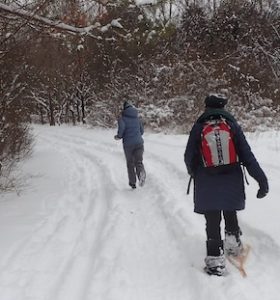
Heading for home on the NCC’s multi-use trail: room for skiers, joggers, and snowshoers
We ate in a place where fallen trees made ready lunch seats, then launched ourselves again to take off the chill of just sitting around. Peggy soon led us out into a clearing that Rob identified as “Pond XV” — an isolated vernal pond that was the only landmark we encountered in the course of an hour. Under the snow, the ice was slushy. Rob consulted a compass to choose our next direction.
As he expected, we soon came out on well-travelled trail that took us past our Study Tree Woods. Erik and Kaisa and Mozz checked their trees, and Robin chose a new one, perhaps because he could see a Hairy Woodpecker working high up in it. The only other birds the group saw or heard were a Raven, flying by to check us out, and a Pileated Woodpecker, also flying by, calling. We had a single mammal sighting, a Red Squirrel whisking up into the treetops.
January 10, 2026: Rabies hasn’t gone away!
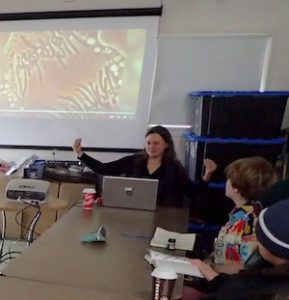
Speaker Tamara Checkland explaining mitosis
Before our speaker could even begin her presentation, we went off on a tangent. Member Alma was recounting how, in school, she had been looking through a microscope at cellular division in an onion root tip — “mitosis.” Suddenly there was a video on screen showing just what she was describing. Our speaker, Tamara Checkland, was waiting her turn with projector running. She is a molecular biologist, and knew just where to find relevant footage — chromosomes assembling, pulling apart, and regrouping on opposite sides of a cell’s nucleus — and she knew what to tell us about it.
Tamara works in the health field, including time in a government lab where the bodies of animals suspected of having rabies were sent for confirmation. Her close experience has made her very aware of this and other zoonotic diseases. Rabies, she said, is a horrific disease — always lethal unless treated early with injections of antibodies. And over the past 40 years we have forgotten about it, because of our overwhelming success in vaccinating the classic vector in Ontario — foxes.
It has not been possible to vaccinate bats, however, and Ontario’s first fatal case of rabies in nearly 50 years came from household contact with a bat in Brant County. Some of us have to deal with a bat that turns up in our homes, flying round and round from room to room, and it would be wise to take the greatest of care in catching and releasing them so as not to get bitten.
For rabies, and the other zoonotic diseases she covered, such as Lyme disease and several others, go to reliable websites, she urged — Canadian government health departments can be trusted. Take any possible exposure seriously, she said, and get prompt medical attention. These diseases may be rare, but can be avoided, prevented, or treated so easily through knowledge and action.
December 13, 2025: Explorations in the snow
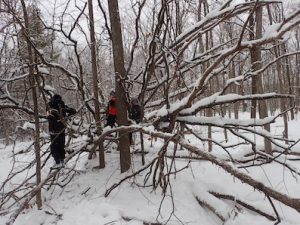
Macoun Club members in fallen treetop
Above all, it was a snowy day. Snow underfoot, deep enough for warmly dressed kids to flop down into, and snow falling thickly from time to time. We took the group around a well-known route that was nevertheless new to those who have joined this autumn. All the animal tracks we saw were deeply snowed in, too, but we could guess them by their patterns and size: Red Fox, White-tailed Deer, Fisher. We were looking especially for Porcupines, but found no signs of them in even the most likely places.
The woods seemed strangely empty of bird life, too. In three hours out, not a single Chickadee, Nuthatch, or Woodpecker. So we looked at trees, focusing on Black Cherry and Butternut. We came across Butternut no. 736 (in the Macoun Club’s survey), which appeared to have a full crown of bare but healthy-looking twigs, and a trunk scarred with elongate, blackened wounds — the hallmark of the Butternut Canker disease that has made this an endangered species.
We had a quick look at our own Study Trees, too — no surprises there.
Nov. 29, 2025: Getting reacquainted with winter
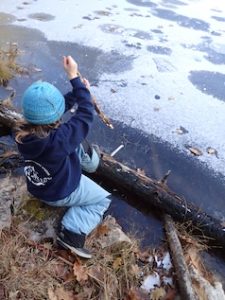
Testing the ice
We’ve had snow, but it had mostly melted away; the ponds havd frozen over, but big stretches of White Lake remained open. We chose a familiar region of rock, pine woods, ponds, and rugged uplands near Rob Lee’s home.
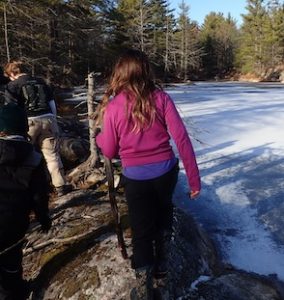
So wild there are not even footpaths to these special places
The only ground where animal tracks were preserved was the little-used track known as the “California Road.” Few vehicles had passed that way, leaving the center and edges as smooth white sheets of delicate powder snow showing the footprints of Red Squirrels ,a Red Fox, a Fisher, and several White-tailed Deer and — a Moose! Those big hoof-prints were spaced as far apart as a man’s long stride. Moose turn up only at intervals of years in this district.
What with animal tracks and ice-covered pot-holes, It took us more than half-an-hour to walk the mile to where we know a hidden gem of a lunch place. (The ice of every pot-hole had to be stomped on, broken, and sometimes examined — “What caused those patterns of white lines?”)
We built lunch fires in last year’s campfire rings. No one else goes there, so firewood is abundant and ready-to-hand on the trees. Right at the foot of the steep slope a short beaver dam led to gentler, shelving shores of granite. The ice was less than an inch thick and so obviously weak that no one ventured to put a foot on it. But we poked and prodded it to the breaking point, and hurled stones and rocks down to see if they’d go through.
Nov 22, 2025: Do you see what I see, colourwise?

We use colour vision to choose our foods
Roy John often gives us illustrated talks on the birds of the world, and as he has shown us, birds are often strikingly coloured — Why? And for that matter, why are mammals usually dull-coloured?
Roy told us that the colouration of animals tends to be related to their capacity to see those colours, and birds have a more refined visual system. Birds’ eyes have four types of the colour sensors known as “cones” while most mammals have just two. What about us? We’re mammals, too. Well, we have three.
So why aren’t we as diversely coloured as birds? While birds may use coloration to distinguish themselves from many similarly shaped species, we’re just one species. Instead, we use colour for the practical purposes of selecting nutritious food: “Is this apple ripe? No, it’s still green.” “Is this meat still good? No, it’s green!”
And are green plants as green as they look? No, Roy said, green leaves also have red and yellow pigments that are masked by the stronger green ones — until autumn (in North America, anyway).
Colour is important in other biological systems, too, such as the co-evolved flowers and their pollinators, and coral reefs.
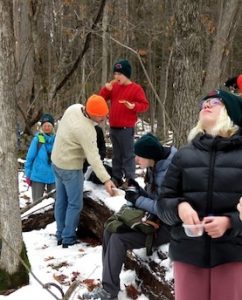
Macoun Club group making themselves at home in the snowy woods
November 15, 2025: Do you want to build a Glaciomimus hominiforma?
On our first outing of the season with snow on the ground, some practical lessons were learned: a thermos makes for a hot lunch; running shoes quickly become cold and wet in snow; and it helps to have something dry to sit on while eating lunch.
In our Study Tree Woods, Rob showed Karl (a member during the 1990s) his long-lost Study Trees, a Red Oak that died decades ago and had fallen down. We brushed off the snow and used it as a lunch bench. Then his children, new members, chose fresh Study Trees.
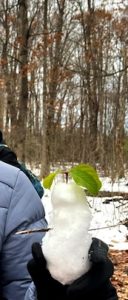
G. hominiforma
Alma and Sardar drew attention to the unusual sight of Pine Grosbeaks eating buckthorn berries, but no matter how much we searched the treetops, we couldn’t spot any of what we expected: Porcupines. On a hunch we looked inside a well-known drainage culvert under the access road, and there it was, smelly porcupine-peanuts and all!
In a different habitat with shallow soil and conifers, we found patches of club mosses, which remain green all year: Hickey’s Tree Clubmoss (Dendrolycopodium hickeyi, previously known as Lycopodium obscuratum) and Stag’s Horn Clubmoss (Lycopodium clavatum.
To finish off the trip, Alma presented us with a different sort of creature… Glaciomimus hominiforma, meaning “ice mimic human-shaped” (the fictional Latin name is from a website called Animal Simulator Wiki). This snowman sported a special leafy hat and has joined the culvert porcupine as an honorary Macoun member.
Nov. 8, 2025: Giants of the Skies

Robbie is an old Macoun member himself
Former member Robbie Stewart knows what thrills Macouners, and devoted his presentation to the biggest creatures that have ever flown — prehistoric reptiles and birds
He began with the biggest birds you might find currently in the Macoun Study Area, such as Great Blue Herons (wingspan 6 feet) and Sandhill Cranes (7 feet), and possibly even the world’s largest existing waterfowl species, the Trumpeter Swan (wingspan up to 10 feet, or 3 metres). Modern birds don’t get much bigger than that.
In past geological ages, however, our Study Area could have hosted truly immense creatures, with wingspans up to 24 feet, or 10.4 m (the pterosaur Quetzlcoatius, from 25 million years ago), but erosion has removed the fossil record locally.

Ever wonder how pterodactyls got airborne?
In other places with more complete records, however, fossils tell us not just how big fliers could be, but what kind of flying they might have done, and crucially, how they could have got into the air.
Some fliers would have actively beaten their wings; others would have soared. Robbie explained how you (as a pterosaur, a bird, or a glider pilot) can go up on rising air without flapping, when gravity is pulling you down. He talked about “wing-loading” and “aspect ratios.”
As for how to get into the air, the easiest method is to jump off a cliff. Next would have been to have hind legs strong enough to jump into the air. Or perhaps special anatomy would have enabled pterosaurs, with their puny hind legs, to use their long wings, still folded, to vault forward and up.
He ended his talk to thunderous applause.
November 1, 2025: In the grey of November

Having lunch in the woods
It was a grey day in the Study Area, after two days of light rain that ended a drought. It seemed that the change had finally induced some mushrooms to emerge. We saw Yellow Fairy Cups (Bisporella citrina), King Alfred’s Cakes (Daldinia concentrica), Smoked Oysterling (Resupinatus applicatus), Ochre Bracket (Trametes ochracea), among others.

Gypsy Moth pupal case (and shed skin of a caterpillar)
We ate lunch in the Study Tree Woods and each of the new members — Robin, Jasper and Astra — picked out a study tree. A young Porcupine fled up a tree and then eyed us suspiciously from high up; later we found another at the far corner of this 10-acre woods.
Under logs and even leaf litter, we discovered numerous insects, including beetle grubs and a stink bug, as well as some muddy-coloured earthworms and small millipedes, but no salamanders. They must have already moved to winter quarters, where frost can’t touch them.
Rhys found an empty pupal casing in a hollow log, part of a little tableau there that, as Rob pointed out, told a whole life-cycle story of a Gypsy Moth (now called the Spongy Moth by some — Rob would call it the Bristly Defoliator). Next to it was the shed skin of the caterpillar that had pupated, and on the ceiling of the hollow was a distinctively felted patch — a tan-coloured egg mass that had been laid by the very moth that had emerged from the pupal case. Such a mass contains hundreds of eggs!
October 25, 2025: American Eel Conservation and Ecology

Macouners have a special fascination with eels
Former Macoun member Nick Lapointe, PhD, is a Senior Conservation Biologist working on freshwater ecology at the Canadian Wildlife Federation. Today he shared his expertise with us on the American Eel (Anguilla rostrata).
Did you know that American Eels are diadromous? That means they migrate between freshwater and saltwater. More specifically, they are catadromous in that that spawn in saltwater.
For centuries, the life cycle of eels was a complete mystery. The ancient Greeks, including Aristotle, believed eels spontaneously generated from mud. To this day, no one has ever seen eels hatch or release eggs or sperm in the wild. By surveying large areas of the ocean and finding the smallest eel larvae, it was determined that they must spawn in the Sargasso Sea located south of Bermuda. Why can’t they just put trackers on the eels? They have, but the signal is lost once the eels head down deep to spawn.

Sculpture of eel in Ottawa
Nick showed us the whole migration route and explained the different life stages of the American Eel. The leaf-shaped eel larvae (called leptocephali) drift on North Atlantic currents for up to a year. They then metamorphose into glass eels, tiny and transparent. Leaving the open ocean, they become elvers, taking on colour as they enter sheltered salt-water bays, brackish estuaries or freshwater rivers. Fully pigmented elvers become yellow eels. When eels prepare for their spawning migration, they metamorphose into silver eels.
Poaching and dams are among the biggest threats to eels. Nick explained that new turbines have been designed that greatly reduce how many eels would be killed going through them but companies don’t want to pay to try out these new turbines and there are no regulations that would mandate the use of better turbines.
What can a kid do to help eels? If you ever catch an eel by accident, RELEASE IT!! It’s the law and a study done by CWF and Carleton University showed that by cutting the line or removing the hook, eels can almost always survive.
And the next time you’re travelling along the OC Transpo Confederation line, stop off at Pimisi station and check out the giant statue of the “pimisi” which means “eel” in Algonquin.
October 18, 2025 – Bogs, bones, bugs, and bumps

The floating bog is dotted with Cottongrass seed heads
On a cool October day we had lunch by the bog in Pakenham. The low water levels made it easier than usual to get on the bog … easy enough even for Susan! Owen’s keen eye spotted a long-empty songbird nest on the bog mat — possibly made by one of the Song Sparrows that make a home around the edges of these wetlands, said Rob, because it was made entirely out of grass stalks. Exploring along the edges, Darwin found a small Three-spine Stickleback fish.

The spore-producing parts of a Polypody fern are hidden underneath
One cool find was the “Splendid Earth-boring Beetle” (Geotrupes splendidus). Its vibrant, iridescent colors can change from metallic green to purple or blue depending on the light.
Growing on rocks were ferns (Polypodium virginianum) with rough reddish bumps on the undersides of the leaves. These are sori, formed by sporangia which contain the spores by which these evergreen ferns reproduce.
The only herp find of the trip was a small Red Bellied Snake.
October 4, 2025: Tips on nature collecting
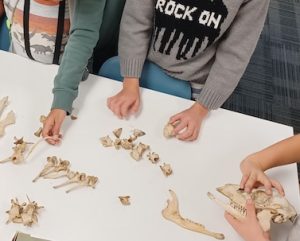
What is it? Macoun members working out the parts of a deer’s skeleton
In a meeting held at Mike Leveille’s school, Mike presented a series of hand-on collecting tips. Having an organized collection that one can learn from — or use to teach — involves preparing specimens (as in pinning butterflies) and having a place dedicated to their display or usefully accessible storage. Some naturalists fill display cases or cabinets, or even just shelves in a bookcase.
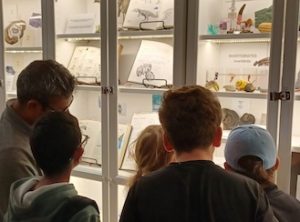
Mike’s best and most informative specimens on display
To keep track of specimens that soon become too numerous to remember readily, writing a number on the piece of rock or bone, or the cardboard a lichen or plant specimen is fastened to is matched by a numbered list of specimens. As one lichenologist told Rob Lee, “You can never have too many notes!” He meant that in addition to a name, it is wise to record the date and place where the item was found, and any special circumstances.
Mike explained some of the methods one can use in mounting specimens and had Macoun members practise some of them on material he provided.
September 20, 2025: Nature-art workshop
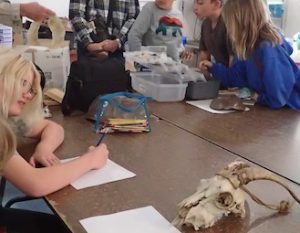
Macoun Club members sketched freely for an hour or more
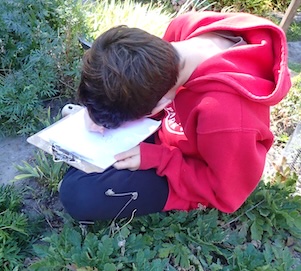
Giving close attention to detail
Some Macoun Club members are always working with pencil and paper, drawing things while observing in nature, while other people are talking, while listening to invited experts giving presentations. Today we gave everyone free run to draw whatever they wanted: we handed out pencils and paper to 20 members, and offered a selection of specimens to work from. (We had wolf, goat and lizard skulls, horseshoe crab shells, among other things.) Some went outside and drew directly from nature in the Backyard Garden.
The results will be published in our own magazine, The Little Bear, next year.
September 13, 2025: Return to our Nature Study Area
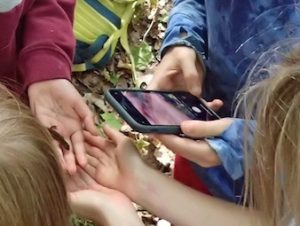
Everyone is eager for hands-on experience
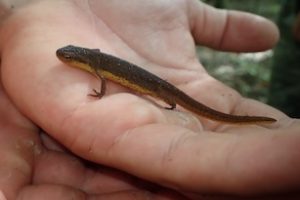
Eastern Newt in hand
How has our Study Area fared during the summer drought, which continues even now? In the past (2001 and 2012) trees on shallow soil over bedrock died from lack of water, changing the character of whole sections of forest. This time the foliage of a few small trees has turned brown, and only small groves have died. Deeper forests, like our Study Tree Woods, are green, top to bottom. On the other hand, the forest floor is still covered with last year’s fallen leaves, indicating that it had not been humid enough for Dew Worms to come out even at night to eat them. Under logs today, we readily found salamanders, but few earthworms.
In fact, we turned up lots of salamanders — Blue-spotted, Red Eft, and Eastern Newt — almost anywhere we looked. And Wood Frogs were out and about.
In the trees overhead were Porcupines, usually high in the canopy of Red Oak trees. But one, a baby of the year, was right down on the hiking trail — a passing jogger merely swung wide around the animal.
We checked out a forgotten pioneer orchard and found only three apples — which we can again attribute to dryness. We had lovely weather for being out, but the natural environment is stressed.
September 6, 2025: Getting to know each other
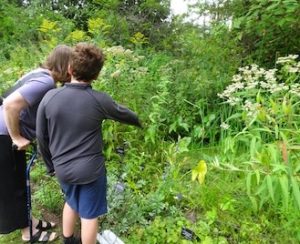
Macouner pointing out a Green Frog in the pond
A summer’s worth of observations to share! We gathered at the Fletcher Wildlife Garden and heard about nature sightings from members we’ve known for years and from kids who had never been with us before. Some had travelled, more than one family to Newfoundland, and one boy to Vancouver Island’s West Coast Trail. Niccolo and Mattia had been to Italy. We heard about crabs and seagulls, jellyfish and eagles. One new boy had made drawings of the insects he wanted to tell us about. Some members showed photos. And then leader Mike Leveille challenged the group to find the Eastern Gray Treefrog he had spotted on the outside of the building. Everyone charged outside, found it, and then soon we had a second amphibian in sight (a Green Frog in miniature pond), and then an American Toad beside the Garden’s Prickly Pear Cactus plant. Everyone could see the Chipmunks running around in the “Backyard Garden” and a few people followed the sound to a Red Squirrel gnawing on a tough Black Walnut. This is how we get to know each other.
It was hard to get everyone back inside, but we wanted to have Mike explain how he will trade members for natural history specimens he carries in his portable Swap Shop. We can trade several common objects for one less common thing, and some of them for things of some rarity. There are four levels.But that wasn’t Shackleton’s last ship. He tried again a few years later in the Quest. Shackleton had never lost a man, but he himself died onboard and was buried on the same island he’d reached in his epic voyage in a small boat. Roy has been to his grave.
The Quest went on for another 30 years, got caught in sea ice off Labrador, and sank. In 2024, Antoine did the research that established the search area. For us, he described with energy and intensity what he had to do, and how the actual search with side-scanning sonar progressed. When the images of the wreck appeared, the smooth sea floor 390 metres down was scored by thin, straight lines, and sparsely dotted. The lines, Antoine said, were left by drifting icebergs dragging on the bottom, and the dots are craters where Greenland boulders, fell out of such huge icebergs and plumped down into the ooze.