

OFNC member takes the Ontario Master Naturalist Program
by Bev McBride
I had my assignment. Find an insect or other invertebrate and describe it in a field journal. It was early March. No problem. There were plenty in the basement. But no, I wanted to find one outside. I hoped it would be alive. I knew they were out there, but how cleverly would they be hiding? It wouldn’t be like May, when you just stand there and numerous insects come right to you. Off I went to Mud Lake.
You might wonder who had the audacity to give me such an assignment, which I accepted with no resistance. I was following the Ontario Master Naturalist Program. Its principal teacher, Bob Bowles, was who.
The Ontario Master Naturalist Program runs through the Community Engagement and Lifelong Learning branch of Lakehead University’s Orillia campus. It was founded 15 years ago by Bowles, a well-known naturalist and ecological consultant, and Ontario Nature. Bob designs and delivers the content of the program. Lakehead provides the online platform and administration. I had long known of the program but, before COVID-19 threw us for a loop, its weekly classroom sessions took place in-person in Orillia.
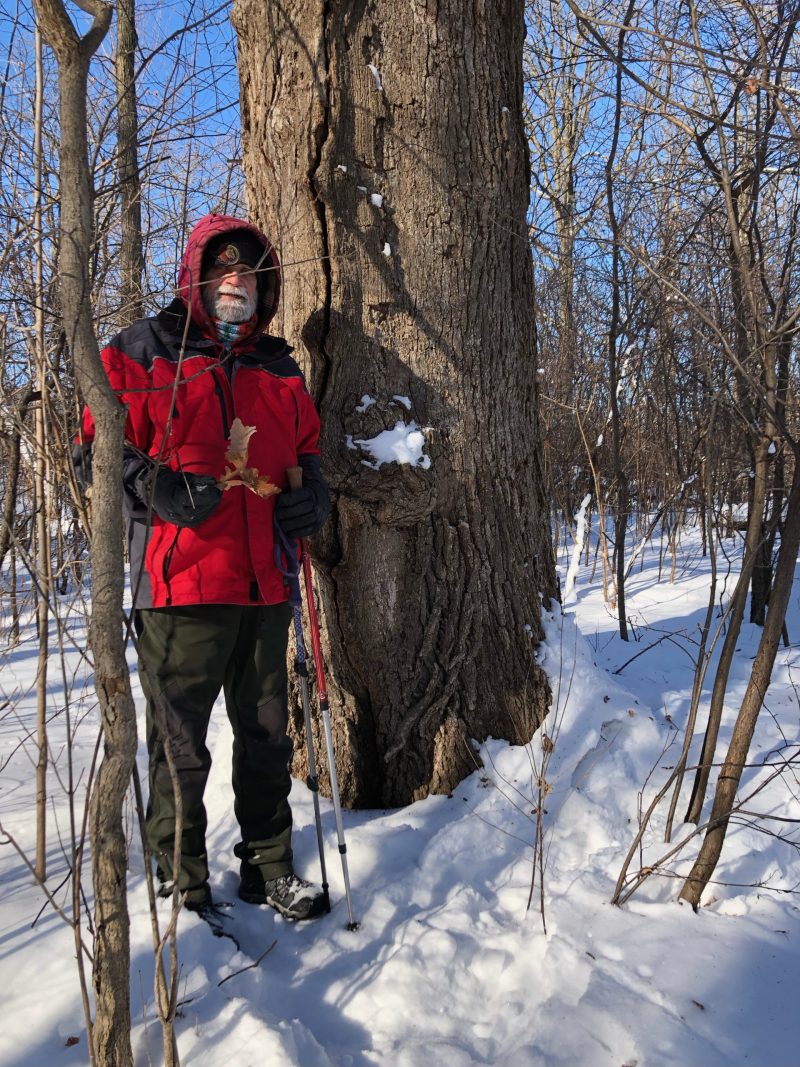
Dave Moore assists with scale during the Plants Module.
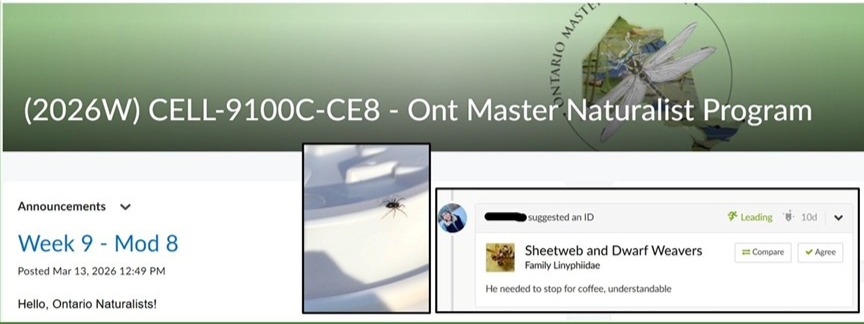
But back to Mud Lake. I was with my friend Jean. I had a take-out coffee in my hand as we strolled along the main trail, chatting, half-focussing on our mission. Quick as lightning, a chickadee flew in and landed on my cup lid. I had neither seeds nor donuts to offer, so it soon took off. When it did, it left behind a tiny, black spider. Thanks! I don’t know if the bird had meant to swallow the spider, or whether the spider had boarded the bird when both were together on a tree. It didn’t matter. I had my invertebrate.
I had not yet read the course materials on spider identification, so I did not remember to use my hand lens to take a good look at its eyes. Eye pattern is key to sussing out your spider’s family. Instead, I followed the very modern ID method of putting it on iNaturalist. It is always better to try to identify a species yourself first. You will certainly learn something. Still, in the rush of daily life, one does sometimes take the lazy route. When another iNaturalist user kindly gave me a family name to go on, I extrapolated backwards to discern the eye pattern it would have, which I then used for my assignment. Please don’t tell my teacher or classmates about this shortcut. I’m not proud of it.
Sneaky shortcuts aside, what is a naturalist, nowadays? This is the course’s stated purpose: “The Ontario Master Naturalist Certificate Program is aimed at naturalists and those dedicated to environmental stewardship, empowering them to learn and share knowledge of the natural world, and engage as stewards of their local ecosystems and resources.” My classmates were teachers, artists, community activists, landowners, forestry technicians, and nature tourism operators. They were knowledgeable and keen.
I wonder how many more people out there would like to follow such a program. Through Internet searching I could not find another master naturalist program in Canada. Is this the only one? I’ve heard of one being developed in Manitoba. They’re common in the United States. They often work in tandem with citizen science programs. You can read more in this article from Audubon Magazine, Fall 2023: You’ve Got What It Takes to Become a Master Naturalist | Audubon.
Registration is now available for the spring session. Here’s a link: Certificate Program | Lakehead University
I can recommend the program. It is rich with information. You’ll meet friendly, like-minded people. You’ll be asked to make weekly field journals. Field journals are great way to learn to pay attention to details, especially if you make your own sketches. You’ll be asked to make a presentation and to work with teammates to design a quiz. Then there are the weekly ID challenges. Some of the course content focusses on the Orillia area where the program was first developed. Still, I found it easy to relate that material to parts of the province I know. You’ll have opportunities to contribute your own knowledge and insights. The tuition was on the expensive side, just over $600 for the winter session. You could fill up all your days with this course, if you had such leisure.
Am I a master naturalist now? Uh. Hm. I certainly have increased my mastery of the adage, “The more you know, the more you know you don’t know.” “Master” is what’s known as a loaded word. I’ll uphold the program’s purpose, in my own way, because I believe in it.


A delightful and helpful article — thank you!