

Text and photos by Jakob Mueller
Recently, a report of a “rattlesnake” in a local greenspace got some media attention. The observer reported that the blotchy snake, when found by her dog, shook its tail and made a sound – as a rattlesnake would – so she urged caution. This was a case of mistaken identity, and a particular point of confusion that happens with some frequency in the area.
Ontario, being the big and biodiverse place that it is, once hosted two species of rattlesnake – the Timber Rattlesnake, which is now extirpated from Canada, and the Eastern Massasauga, which is still found in some areas. However, while both of these species once had a larger distribution than they do today, their ranges never included the Ottawa region, and they are certainly not here now.
Many areas around Ottawa are home to Eastern Milksnakes. Generally secretive, and rarely abundant anymore, these animals have a brown and blotchy appearance. When cornered, they may perform some bluff behaviours that mimic an upset rattlesnake. They will raise their head and coil their neck, facing their threat. They simultaneously vibrate their tail, which does not have a rattle, but can sound like one in grass or dry leaves. This behaviour, and a preferred habitat, gave the snake one of its original (but antiquated) names, “Hardwood Rattler.”
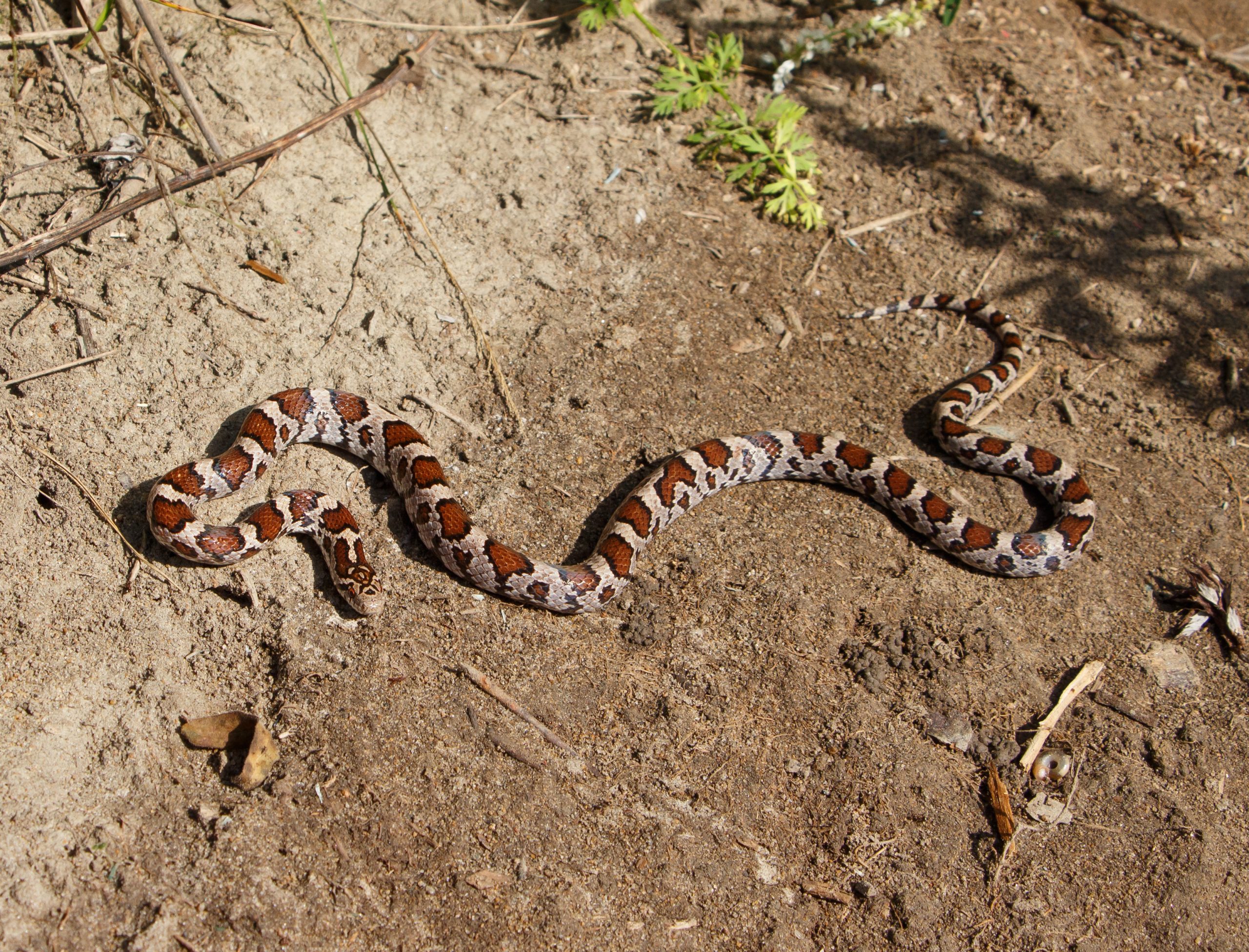
A juvenile Eastern Milksnake found in east Ottawa.
Why pretend to be a rattler?
The advantage of mimicking a rattlesnake is the same reason that a dog walker might be wary of one: rattlesnakes are venomous. There are many species of venomous snakes in the world, and these include all of the snakes with genuine rattles on their tails. The venom from many of these snakes can be medically significant, and in some cases life-threatening, so caution is warranted. However, it is also important to note that caution and respect will keep one out of danger: bites are only ever delivered defensively, despite what some sensationalized accounts may claim. The rattles on rattlesnakes are used as a warning device, to prevent conflict in the first place. The majority of snake bites in the United Snakes are experienced by younger men on their upper extremities – these are generally results of attempts to pick up the snake, or attempts to kill the snake.
Eastern Milksnakes use their mimicry and their superficial resemblance to rattlesnakes to bluff their way out of danger. A fox or bird of prey looking for a meal might not want to take the chance. Of course, a human with a revulsion towards snakes might not act with as much deference, and the combination of direct persecution and habitat fragmentation have caused the Eastern Milksnake to decline – once common, they are now listed as “Special Concern” federally by COSEWIC.
The tail-rattling warning alone is not unique to milksnakes by any means. Elsewhere in Ontario, another blotchy snake, the Eastern Foxsnake, also rattles its tail when nervous. Ratsnakes in the nearby Frontenac Arch will also do this, even though they are generally black in colour and otherwise do not resemble a rattlesnake. The Eastern Hognose Snake has an incredibly theatrical, but very different bluff defence, which involves flattening its head like a cobra (despite North America not having any cobras) and hissing very loudly.
What’s the difference?
Milksnakes are not frequently encountered. Combined with their increasing rarity, they are skilled at being cryptic, and are crepuscular or nocturnal when the weather after sunset is warm enough. This means that most people have not seen one, and when they do, they are unfamiliar. Googling a blotchy snake in Ontario brings up a number of species, but people tend to gravitate towards the images of the Eastern Massasauga. The latest episode was by no means the first time a “Massasauga” was reported locally after a milksnake sighting. In one incident a few years ago, an observer posted a photo of “the snake they saw” to prove it – which after some investigation, was found to be a Google Image search result of a Massasauga, which that person believed bore a resemblance the snake they saw.
Those with herpetological experience do not think Eastern Milksnakes and Massasaugas look alike – not in the least. This is akin to a sharp and experienced birder readily recognizing 12 species of warblers in a mixed flock, while a novice simultaneously sees a bunch of flitty yellow things. However, both snakes are brown and blotchy, and it isn’t particularly easy to describe how those shades of brown are different, even though they visually are. Without some training or experience, people can’t be blamed for finding those image searches confusing. Below is an explanation of some of the differences.
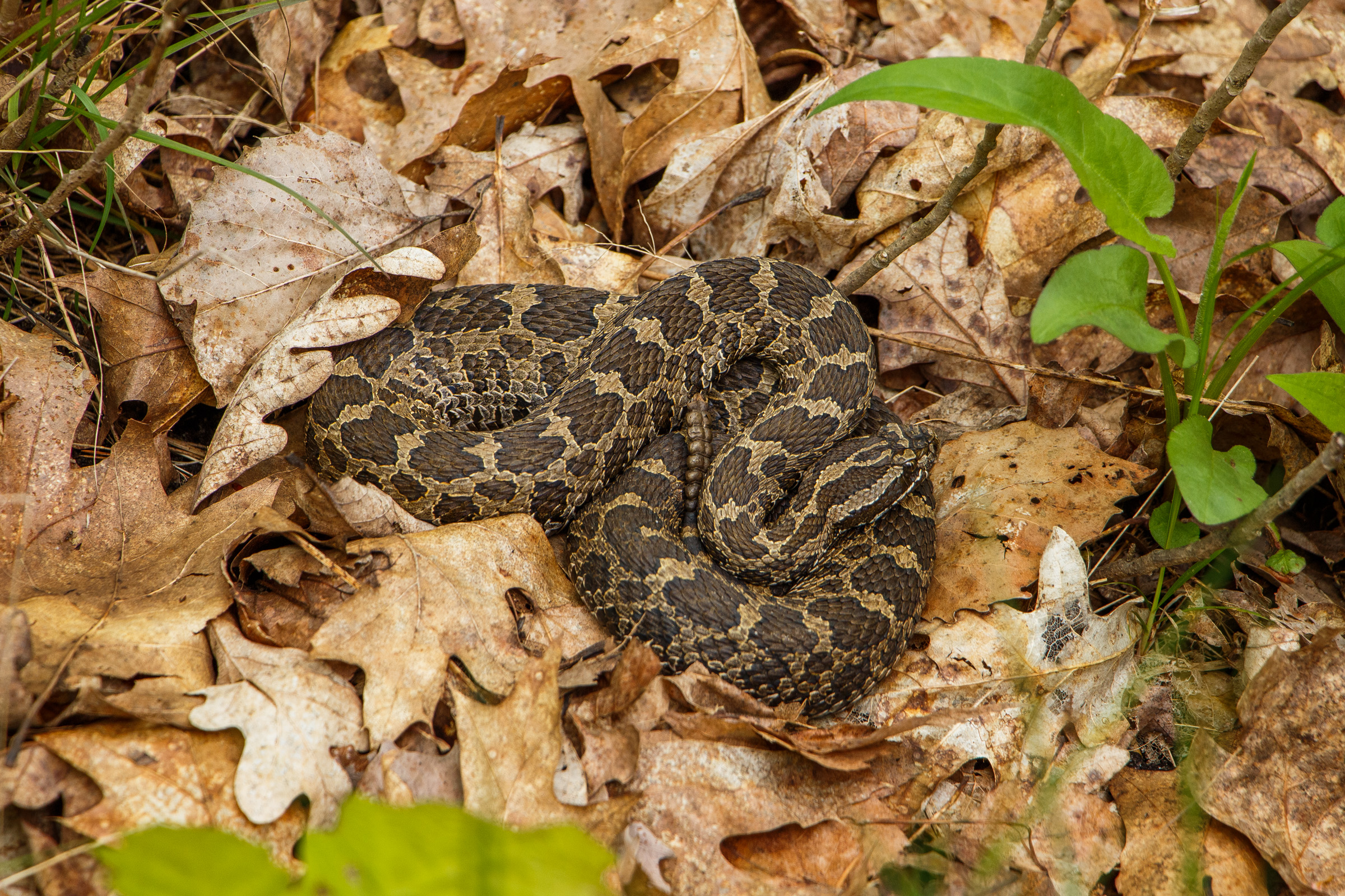
An Eastern Massasauga coiled in leaf littler, near Georgian Bay. Note the rattle on the end of the tail, visible to the left of the head.
A Massasauga, like all rattlesnakes, is a pit viper. In nature, it is an ambush predator of rodents. It has a stocky body plan, as it does not need to move rapidly – for feeding, it simply needs to deliver a burst of power in a strike. It has a rattle, of course, made of segments of keratin, on the end of the tail; these get longer with age but segments can also break off. A baby Massasauga will only have a single segment, called a “button,” which can be hard to see and would not make much noise.
An Eastern Milksnake is a constrictor. It has a more slender body plan, as it moves around more actively searching for its prey. It also needs to squeeze into small holes and crevices (where mice, a.k.a. dinner, might be hiding). It does not have a rattle on its tail – which as noted does not mean it cannot rattle its tail.
In general, both species have dark brown blotches on a lighter brown or greyish background. A younger Massasauga might have a more silvery-grey base colour, and a younger Eastern Milksnake might have a light grey, silver, or white base colour and reddish blotches. These tone down over time.
The blotches on an Eastern Milksnake are irregular and vary from individual to individual, but are generally round-ish or oval in shape. The blotches down the back of a Massasauga are distinctly saddle-shaped. Don’t look at an individual blotch on either snake, look at the series of blotches.

Two adult Eastern Milksnakes found in the eastern Ottawa Greenbelt, showing some normal variation in shades of brown. Compare with the Massasauga image above, and note the more slender bodies, the roundish blotches, and the glossier appearance from the smooth scales.
The sides of an Eastern Milksnake will appear smooth and glossy – this is because they have smooth scales, which is often an important herpetological feature for identification. The scientific name of the Eastern Milksnake is Lampropeltis triangulum, and the genus “Lampropeltis” means “shiny shield” in reference to these scales. (The species “triangulum” refers to the blotch on the back of the head being triangular; this is usually the case with our local snakes but is not reliable across the species’ range.)
Conversely, the sides of a Massasauga will appear dull and rough. This is because they have keeled scales, rather than smooth ones. Looking closely at an individual scale, there is a raised ridge down the centre. Many common non-venomous species also have keeled scales, including Eastern Gartersnakes and Northern Watersnakes, but the smoothness of milksnakes helps distinguish them specifically.
Other, less visible differences
Some of the classical ways to separate venomous and non-venomous snakes are unreliable and do not work in all cases globally. One is that snakes with vertical pupils are venomous, and those with round pupils are non-venomous. In this case, it happens to be true – but please note it doesn’t work for all species in all parts of the world, and because it requires you to look closely at a snake’s eyes, it isn’t necessarily practical in terms of field safety.
Another oft-cited false maxim is that venomous snakes have broad, triangular heads and non-venomous snakes do not. In this case, Massasaugas have a lance-shaped head – not really a triangle – while Eastern Milksnakes don’t really have a distinct neck. However, some other non-venomous snake species have larger, blockier heads, or can puff up their heads to look triangular, including our local Eastern Gartersnakes and Northern Watersnakes. This concept has proven dangerous for both snakes and humans. Some watersnake species elsewhere in North America can display very triangular heads, which leads to them being mistaken for “Water Moccasins” and killed. Conversely, some particularly venomous snakes in the world – like coral snakes, or cobras not displaying a hood – don’t have particularly prominent heads, but should be left alone.
Massasaugas are solenoglyphous, meaning they have folding fangs at the front of their mouths. They also have heat-sensing pits, between their eyes and nostrils, which help them detect mammalian prey and direct their strike in the dark. Milksnakes are aglyphous, meaning they lack fangs and all their teeth are relatively similar in size. They lack heat pits and are aided in their search for prey by smell. Of course, these differences aren’t necessarily helpful for field ID, as getting close to the snake’s face (let lone examining its teeth) is not advisable.
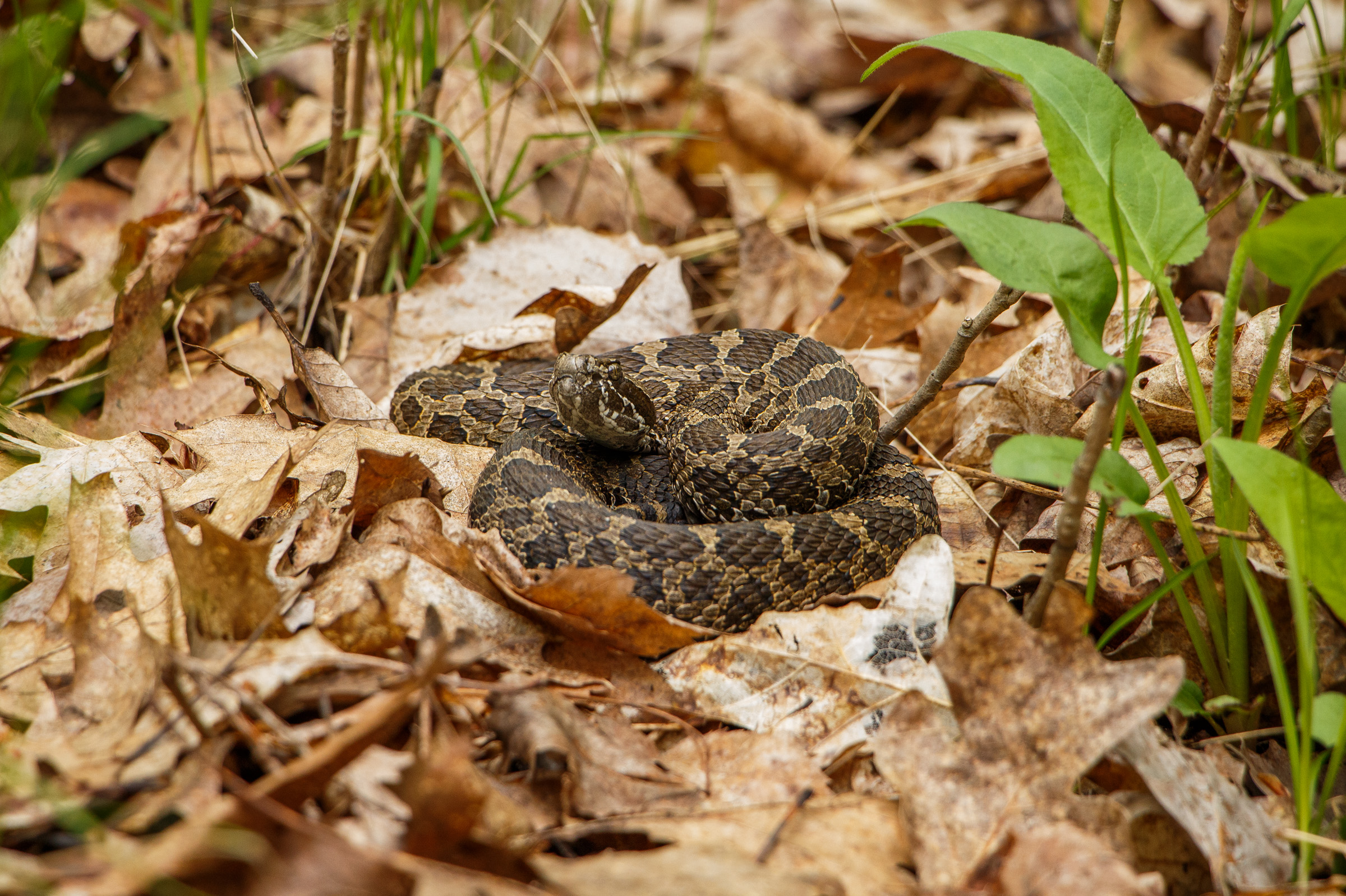
From this angle, the rattle on this Massasauga is not visible – but the saddle-shaped blotches on the rough, keeled scales distinguish it from an Eastern Milksnake. One of the heat-sensing pits is visible just to the left of the snake’s eye with a vertical pupil – small ID features that are impractical to rely on for inexperienced observers.
What should you do if you see an Eastern Milksnake?
If you do spot an Eastern Milksnake, enjoy and appreciate your encounter with a wild animal, as much as you might watching an eagle or a fox. For any snake you encounter, try and take a good photo if you can, and upload your observation to iNaturalist. Observations of all snake species are valuable as they help us understand where snakes are persisting and how they are doing. Most importantly, let the snake live – it is an important part of the ecosystem.
You might encounter an Eastern Milksnake (or other snakes) if you lift up an object that has been lying in their habitat outside – a board, a tarp, a box, etc., especially if mice were also underneath previously. If you do, let the snake move out of that spot before setting the object back down, so you don’t inadvertently injure it – it is best to let the snake crawl back under on its own.
A final note about the Eastern Massasauga
The Eastern Massasuaga is a species at risk, and is legally protected in every part of its range. While it is venomous, there is no reason to fear it; it is docile and will not hurt anyone who respectfully leaves it alone. If you are close when you first see it, calmly step back. It does not move quickly, it will not chase you, and it cannot strike more than half the length of its body. Keep a respectful distance, admire the animal briefly (and take a photo for iNaturalist if possible), then move away.
In Ontario, only two people have ever died from a Massasauga bite, and this has not happened in over 60 years. In both cases, the bitten person did not seek medical attention. If you are in an area where Massasuagas still live and you are bitten, stay calm and go to the hospital. There are a handful of bites every summer – most in avoidable circumstances – and all hospitals in these areas have effective antivenom. For defense, it prefers to use camouflage first. A nervous snake will try to leave, if it can escape safely. If it feels it has been spotted, it may rattle a warning. A defensive strike is the last resort; Massasuagas are one of the more timid rattlesnakes and are certainly more cautious than most of Ontario’s other (non-venomous) species. You would also have to be close enough for a bite to connect, which again, is mitigated by respectful distance.
Massasaugas can still be found around the eastern side of Georgian Bay, on the Bruce Peninsula, and at two small locations in Southwestern Ontario. They no longer live in most areas where they were once found. In the United States, most remaining populations are small and highly fragmented. They fare poorly crossing roads. The survival of this species particularly depends on good conservation in Ontario and in Michigan. While they are very much at-risk and not secure in Ontario, our remaining Massasaugas are a significant portion of the global population.
Because Massasaugas do not occur in the Ottawa area, when people mistakenly think they have found one, the first response is invariably, “don’t worry, we don’t have any venomous snakes here”. While that is true, and a shortcut to comfort, it does not ameliorate fear of certain species. Venomous snakes are equally deserving of being valued and respected as wildlife, and are important to their respective ecosystems in ways that tend to be valuable to humans. Ontario has already lost its populations of another incredible species, the Timber Rattlesnake. We have both an opportunity and an obligation to conserve the Massasauga (and all snakes), which starts with appreciation and respect.



Milk Snakes are not found in most of Eastern Ontario – though there are some signs of them moving east.
Schueler, Frederick W. 2021. POSSIBLE HIBERNACULAR LIMITATION OF SNAKE SPECIES ON THE EASTERN ONTARIO CHAMPLAIN SEA PLAIN. In Eastern Ontario the range limit of Milk Snakes (Lampropeltis triangulum) is a curved line, between Ottawa and Brockville, that corresponds to the eastern edge of the Frontenac Axis and the limestone escarpments along the Ottawa and St Lawrence Rivers. This pattern makes it plausible to think that northern Milk Snakes are limited to areas with small-scale topography, escarpments, and broken rock, because these provide a kind of hibernacula, which aren’t available in most of easternmost Ontario. Ribbon Snakes (Thamnophis sauritus) show a similar pattern, as do Rat Snakes (“Pantherophis spiloides”) and Brown Snakes (Storeria dekayi), though not extending as far north. I will discuss these patterns, and the possibility that if the construction of super-optimal hibernacula in eastern Ontario led to increased populations of various Snakes, this hypothesis would be supported. Canadian Herpetological Society, 2021 Virtual Conference, September 17-19th https://canadianherpetology.ca/conf/docs/2021/CHS%202021%20Conference%20Program.pdf